

How To Install Pandas For Python 3
Pandas Series is a one-dimensional labeled array capable of holding information of any blazon (integer, string, float, python objects, etc.). The axis labels are collectively called alphabetize. Pandas Serial is nothing but a column in an excel sail.
Labels need not be unique but must be a hashable type. The object supports both integer and label-based indexing and provides a host of methods for performing operations involving the alphabetize.
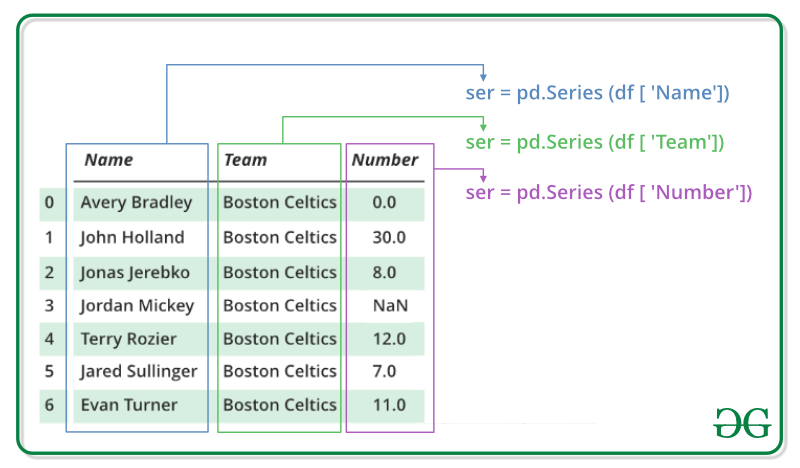
In this article, nosotros are using nba.csv file.
We will get a brief insight on all these bones operations which tin can exist performed on Pandas Series :
Creating a Pandas Serial
In the real world, a Pandas Serial will be created by loading the datasets from existing storage, storage can exist SQL Database, CSV file, and Excel file. Pandas Series tin can be created from the lists, dictionary, and from a scalar value etc. Series can be created in different ways, here are some ways by which nosotros create a series:
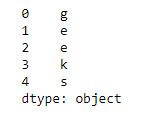
Creating a series from array: In social club to create a serial from array, nosotros have to import a numpy module and have to apply array() function.
# import pandas as pd import pandas as pd # import numpy equally np import numpy as np # simple array data = np.array(['g','e','eastward','k','s']) ser = pd.Series(information) impress(ser)
Output :
Creating a series from Lists:
In guild to create a serial from listing, we have to offset create a listing after that we can create a series from list.
import pandas as pd # a simple listing list = ['g', 'e', 'e', 'k', 's'] # create series form a list ser = pd.Series(list) print(ser)
Output :
For more than details refer to Creating a Pandas Serial
Accessing element of Series
There are two ways through which we can admission element of series, they are :
- Accessing Element from Series with Position
- Accessing Element Using Characterization (index)
Accessing Chemical element from Serial with Position : In social club to access the series element refers to the index number. Utilise the alphabetize operator [ ] to admission an chemical element in a series. The index must exist an integer. In order to admission multiple elements from a series, we utilize Slice operation.
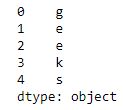
Accessing first 5 elements of Series
# import pandas and numpy import pandas every bit pd import numpy as np # creating simple array data = np.array(['g','due east','e','1000','s','f', 'o','r','m','e','e','g','southward']) ser = pd.Serial(data) #retrieve the first chemical element print(ser[:five])
Output :
Accessing Element Using Characterization (index) :
In order to access an chemical element from series, we have to set values by index label. A Series is like a fixed-size dictionary in that you can become and gear up values by alphabetize label.
Accessing a single element using index characterization
# import pandas and numpy import pandas as pd import numpy as np # creating unproblematic array data = np.array(['g','east','e','m','s','f', 'o','r','grand','e','due east','thousand','s']) ser = pd.Series(information,index=[ten,xi,12,13,14,15,xvi,17,18,xix,twenty,21,22]) # accessing a element using alphabetize element impress(ser[sixteen])
Output :
o
For more details refer to Accessing element of Series
Indexing and Selecting Data in Serial
Indexing in pandas means simply selecting particular information from a Series. Indexing could mean selecting all the data, some of the data from item columns. Indexing can besides be known as Subset Selection.
Indexing a Series using indexing operator [] :
Indexing operator is used to refer to the square brackets following an object. The .loc and .iloc indexers besides utilise the indexing operator to make selections. In this indexing operator to refer to df[ ].
# importing pandas module import pandas as pd # making data frame df = pd.read_csv("nba.csv") ser = pd.Serial(df['Proper noun']) information = ser.head(x) information 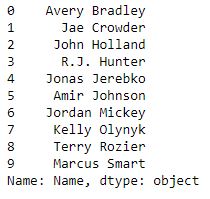
Now we access the element of series using index operator [ ].
# using indexing operator data[3:vi]
Output :
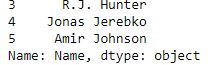
Indexing a Series using .loc[ ] :
This part selects data past refering the explicit index . The df.loc indexer selects data in a unlike way than just the indexing operator. It can select subsets of information.
# importing pandas module import pandas equally pd # making data frame df = pd.read_csv("nba.csv") ser = pd.Series(df['Proper noun']) information = ser.head(10) data
Now we admission the element of series using .loc[] function.
# using .loc[] function data.loc[three:six]
Output :
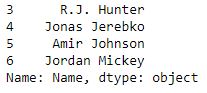
Indexing a Series using .iloc[ ] :
This office allows u.s.a. to retrieve data by position. In lodge to do that, we'll need to specify the positions of the information that nosotros desire. The df.iloc indexer is very like to df.loc but only uses integer locations to make its selections.
# importing pandas module import pandas as pd # making information frame df = pd.read_csv("nba.csv") ser = pd.Series(df['Name']) data = ser.head(10) data
Now we admission the chemical element of Series using .iloc[] function.
# using .iloc[] office data.iloc[3:6]
Output :
Binary Operation on Series
We tin perform binary operation on serial like addition, subtraction and many other operation. In club to perform binary functioning on series we have to utilize some role like .add together(),.sub() etc..
Lawmaking #one:
# importing pandas module import pandas as pd # creating a series data = pd.Series([5, 2, 3,seven], index=['a', 'b', 'c', 'd']) # creating a serial data1 = pd.Series([i, 6, 4, 9], index=['a', 'b', 'd', 'eastward']) print(data, "\n\due north", data1)
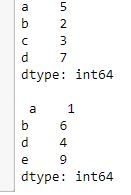
Now we add together ii series using .add() function.
# calculation ii series using # .add data.add(data1, fill_value=0)
Output :
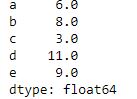
Code #2:
# importing pandas module import pandas as pd # creating a series information = pd.Series([5, 2, three,7], index=['a', 'b', 'c', 'd']) # creating a serial data1 = pd.Series([1, 6, 4, ix], index=['a', 'b', 'd', 'e']) impress(data, "\n\n", data1)
Now we subtract two series using .sub function.
# subtracting ii series using # .sub data.sub(data1, fill_value=0)
Output :
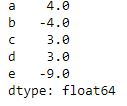
For more details refer to Binary operation methods on series
Conversion Operation on Series
In conversion performance we perform various operation like changing datatype of series, irresolute a serial to list etc. In order to perform conversion operation we have diverse function which aid in conversion like .astype(), .tolist() etc.
Lawmaking #1:
# Python programme using astype # to convert a datatype of series # importing pandas module import pandas as pd # reading csv file from url data = pd.read_csv("nba.csv") # dropping null value columns to avoid errors data.dropna(inplace = True) # storing dtype before converting earlier = data.dtypes # converting dtypes using astype data["Salary"]= data["Salary"].astype(int) data["Number"]= data["Number"].astype(str) # storing dtype after converting later = data.dtypes # printing to compare impress("BEFORE CONVERSION\due north", earlier, "\due north") impress("AFTER CONVERSION\n", after, "\n") Output :
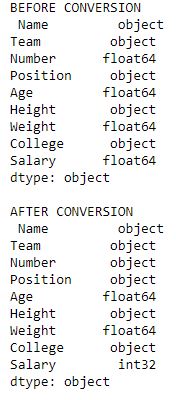
Code #2:
# Python program converting # a series into list # importing pandas module import pandas as pd # importing regex module import re # making data frame data = pd.read_csv("nba.csv") # removing null values to avoid errors data.dropna(inplace = Truthful) # storing dtype before operation dtype_before = type(information["Salary"]) # converting to list salary_list = information["Salary"].tolist() # storing dtype subsequently operation dtype_after = type(salary_list) # printing dtype impress("Data type earlier converting = {}\nData type after converting = {}" .format(dtype_before, dtype_after)) # displaying list salary_list Output :
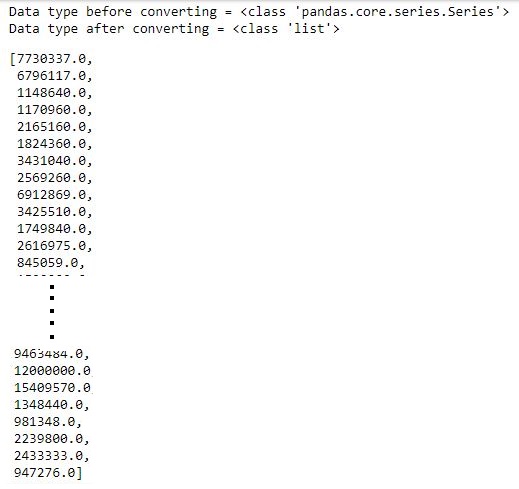
Binary performance methods on series:
| Part | Description |
|---|---|
| add() | Method is used to add together serial or list like objects with same length to the caller serial |
| sub() | Method is used to subtract series or list similar objects with same length from the caller series |
| mul() | Method is used to multiply series or list like objects with same length with the caller series |
| div() | Method is used to split serial or list like objects with same length past the caller series |
| sum() | Returns the sum of the values for the requested axis |
| prod() | Returns the product of the values for the requested axis |
| hateful() | Returns the mean of the values for the requested axis |
| pow() | Method is used to put each element of passed series as exponential ability of caller series and returned the results |
| abs() | Method is used to get the accented numeric value of each element in Series/DataFrame |
| cov() | Method is used to find covariance of two series |
Pandas serial method:
| Function | Description |
|---|---|
| Series() | A pandas Serial can exist created with the Series() constructor method. This constructor method accepts a variety of inputs |
| combine_first() | Method is used to combine 2 series into one |
| count() | Returns number of non-NA/zilch observations in the Serial |
| size() | Returns the number of elements in the underlying data |
| name() | Method allows to requite a name to a Serial object, i.e. to the column |
| is_unique() | Method returns boolean if values in the object are unique |
| idxmax() | Method to excerpt the alphabetize positions of the highest values in a Series |
| idxmin() | Method to extract the alphabetize positions of the everyman values in a Series |
| sort_values() | Method is called on a Series to sort the values in ascending or descending order |
| sort_index() | Method is chosen on a pandas Serial to sort it by the alphabetize instead of its values |
| head() | Method is used to render a specified number of rows from the outset of a Series. The method returns a brand new Series |
| tail() | Method is used to return a specified number of rows from the terminate of a Series. The method returns a brand new Series |
| le() | Used to compare every element of Caller series with passed series.It returns Truthful for every element which is Less than or Equal to the chemical element in passed series |
| ne() | Used to compare every element of Caller serial with passed serial. It returns True for every chemical element which is Not Equal to the chemical element in passed series |
| ge() | Used to compare every chemical element of Caller series with passed series. It returns True for every element which is Greater than or Equal to the element in passed series |
| eq() | Used to compare every element of Caller serial with passed series. It returns True for every element which is Equal to the element in passed series |
| gt() | Used to compare two serial and return Boolean value for every respective element |
| lt() | Used to compare ii series and return Boolean value for every respective element |
| clip() | Used to clip value below and to a higher place to passed Least and Max value |
| clip_lower() | Used to clip values beneath a passed to the lowest degree value |
| clip_upper() | Used to clip values above a passed maximum value |
| astype() | Method is used to change information type of a series |
| tolist() | Method is used to catechumen a series to list |
| get() | Method is chosen on a Series to extract values from a Series. This is alternative syntax to the traditional subclass syntax |
| unique() | Pandas unique() is used to run into the unique values in a detail column |
| nunique() | Pandas nunique() is used to get a count of unique values |
| value_counts() | Method to count the number of the times each unique value occurs in a Series |
| factorize() | Method helps to go the numeric representation of an array by identifying singled-out values |
| map() | Method to tie together the values from one object to another |
| betwixt() | Pandas betwixt() method is used on series to check which values lie between first and second argument |
| apply() | Method is called and feeded a Python office every bit an statement to utilise the function on every Series value. This method is helpful for executing custom operations that are not included in pandas or numpy |

Source: https://www.geeksforgeeks.org/python-pandas-series/
Posted by: lowefout1969.blogspot.com
0 Response to "How To Install Pandas For Python 3"
Post a Comment